Sponsored by the Green Sanctuary Committee
Menu for the Future is a six-session course exploring the connection between food and sustainability, the national focus of the UUA this year. The Green Sanctuary Committee offered the course to the community and in the promising days of early spring 2009, a group of eleven participants met to discuss the curriculum provided by the Northwest Earth Institute.
‘NWEI www.nwei.org is recognized as a national leader in the development of innovative programs that empower individuals and organizations to transform culture toward a sustainable and enriching future. Today, NWEI offers seven study guides for small groups. These self-guided discussion courses are offered in workplaces, universities, homes, faith centers, neighborhoods, and community centers throughout North America. Each program encourages participants to explore values, attitudes, and actions through discussion with other people.”
Discussion Course Goals for Menu for the Future:
• To explore food systems and their impacts on culture, society and ecological systems.
• To gain insight into agricultural and individual practices that promote personal and ecological well-being.
• To consider your role in creating or supporting sustainable food systems.
In the first session we considered the effects of modern industrial eating habits on culture, society and ecological systems. We discussed enlightening articles by authors like Michael Pollen and Wendell Berry, who wrote that how we eat as individuals determine “how the world is used.” Suggestions were offered on how we can begin to eat responsibly by learning the origins of the food we buy, buying local, preparing our own food etc. Our eating rituals are “carried out in a remarkable obliviousness to the causes and effects, the possibilities and purposes, of the life of the body in this world.”
Another session examined the ecological and economic impacts that have accompanied the changes in how we grow and prepare food. We learned some unsettling statistics in an article by James E. Horne and Maura McDermott. For “every unit of food energy eaten in the United States, nearly 10 units of energy are spent producing it, processing it, and shipping it to our tables.” Thomas Starrs wrote an article about reducing our dependence on energy by eating lower on the food chain, more fresh foods, fewer processed foods and buying locally grown food, supporting area farmers.
The following week we considered how individuals could make choices that lead to a more sustainable food supply. Todd S. Purdum wrote about Joel Salatin, one of the natural food movement’s most prolific authors. Salatin runs a successful and profitable family farm system that relies on “age-old precepts of organic agriculture, up-to-the-minute technology” and, most of all, his ingenuity using modern technology on his organic farm that allows him “to do better what nature does itself.” www.polyfacefarms.com/principles.aspx
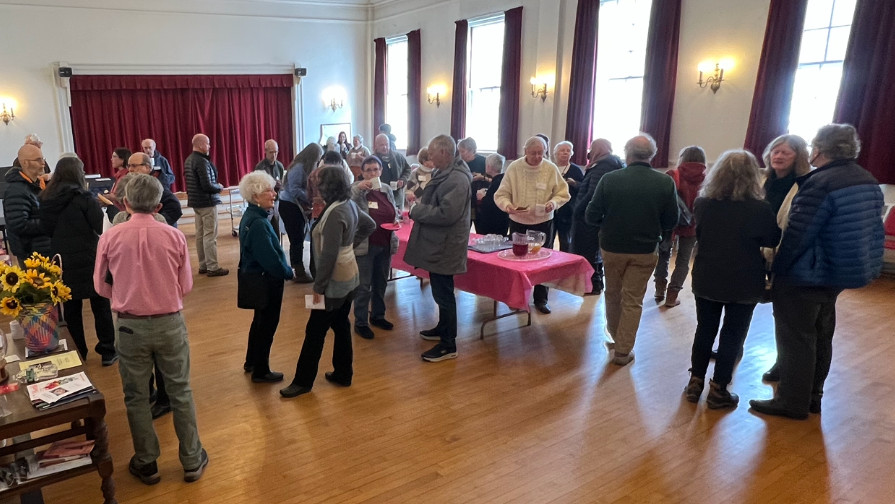
As the weeks progressed our understanding of food systems increased and we found ourselves making more conscious choices in where and how we shopped for the food we eat, what we fed our families, and what impact our purchases and ultimately our life-styles had on the well-being of the planet. The final session, as we shared a meal, culminated in an energized and lively discussion about where we will take our newfound knowledge and how we will use it to create a more just food system. The group continues to discuss ideas and we all look forward to sharing them with the larger church community.
In the fall of 2009, The Green Sanctuary Committee will be sponsoring another NWEI program, Exploring Deep Ecology an eight-session course addressing core values and how they affect the way we view and treat the earth.
Cynthia Orlandella